

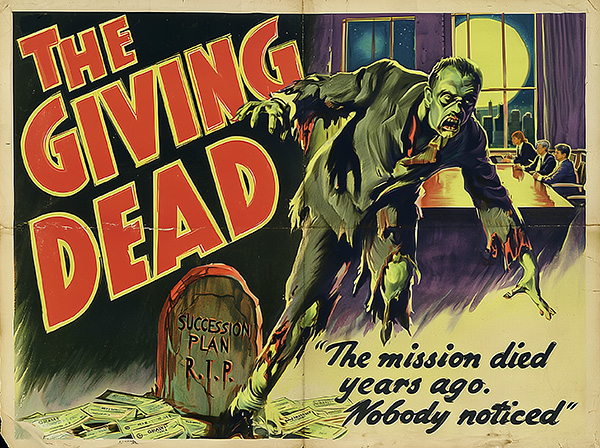
In the spirit of Halloween, we’re taking a lighter look at some serious philanthropic perils and pitfalls. Whether you’re giving now or planning your legacy, here are 13 horrors worth avoiding.
1. Night of the Living Grant
It claws its way back onto the docket every year, approved because it was approved last year. Nobody stops to check for a pulse before signing the check.
Our recommendation: Go back to what each long-standing grant was supposed to accomplish. Renew on purpose, and if things need to change, talk it through openly with the organization.
2. The Haunted Foundation
The founder died, but their wailings of philanthropic intent aren’t being heard from the afterlife. And all the board members around the Ouija board are hearing something different.
Our recommendation: Write down the experiences, values, and hopes behind your giving while you’re still here to explain them. Be clear about what your successors should protect and where they’re free to adapt.
3. The Legend of the Sleepy DAF
The money was laid to rest in the fund years ago, and it has been resting peacefully ever since. All it needs is a plan to raise it from the grave.
Our recommendation: Give your donor-advised fund a purpose, a grantmaking schedule, and a written succession plan. Decide what you want the money to do, then start using it.
4. Forever Is a Scary Long Time
The foundation was granted eternal life, which sounds like a gift until you read the fine print. Nobody has asked whether future generations want to sign up for an immortal side job.
Our recommendation: Talk through what each time horizon would take in impact, resources, and future leadership. Choose perpetuity or a spend-down on purpose, and come back to the decision as things change.
5. Does Your Philanthropy Have a Pulse?
The meetings shuffle along and the checks keep going out. Hold a mirror up to the grantmaking, though, and there’s no reflection of what it’s accomplishing.
Our recommendation: Decide what progress would look like, and set aside time to talk about what you’re learning. Let those conversations shape your next round of decisions.
6. The 5% Curse
Around a bubbling cauldron, the board stirred in one payout calculation, a pinch of habit, and not a drop of strategy. Now the minimum is the whole spell, and nobody dares lift the lid to ask what the moment actually calls for.
Our recommendation: Start with your charitable goals, today’s needs, and the commitments you’ve made. Then work with your advisors to see what different spending levels could accomplish and how long they could last.
7. Skeletons in the Estate Plan
Your charitable bequest was written twenty years ago and left for dead, gathering dust in a file drawer nobody opens. Every time someone pulls it out, it rattles with wishes that no longer fit your life, and your heirs will have a bone to pick with whoever left it that way.
Our recommendation: Review your charitable provisions on a regular schedule and after any major life change. Make sure the recipients can still carry out your wishes, and ask your estate attorney how much flexibility makes sense.
8. Don’t Leave Your Heirs a Haunted House
You pictured a family foundation passed down like a treasured heirloom. Your children see a creaky old mansion with your name on the gate, a lifetime of upkeep, and no say in the batty décor.
Our recommendation: Ask the people who might succeed you whether they want to take part, and how. Find ways to give together now, with real roles and room for their own interests.
9. Back from the Dead: The Shambling Foundation
The portfolio lurches off in a new direction every time someone develops a new interest, picking up grants as it goes. It moves and it groans, but there’s no brain steering it.
Our recommendation: Look at your grants side by side with your mission and current priorities. Decide what to deepen, what to rethink, and how to handle any changes fairly.
10. What the Grantees See in the Dark
Your nonprofit partners have seen things in your application process that would make your hair stand on end. They’re just too spooked to tell you.
Our recommendation: Set up confidential ways for grantees to give you honest feedback. Then tell them what you heard, what you plan to change, and what you can’t.
11. Gifts from the Family Crypt
Everyone has a place in the family crypt, but the rules are written in a language nobody can read. Who decides, who breaks a deadlock, and who leads next? The answers are as cryptic as the tomb.
Our recommendation: Agree on roles, decision-making, and succession before a hard moment puts them to the test. Talk about expectations openly and write down what you agree on.
12. The Frankenstein Giving Plan
Your estate documents, charitable vehicles, and giving strategy were each built in a different lab by a different mad scientist. Pull the lever and the creature walks, but every limb is reaching toward a different direction.
Our recommendation: Get your philanthropic, legal, tax, and financial advisors in the same conversation. Make sure the whole plan supports what you want and leaves future decision-makers guidance they can actually use.
13. I’ll Give When I’m Dead
Your giving is scheduled to come alive the day you aren’t. It’s a dead-on plan with one grave mistake: you’ll never get to see it, learn from it, or share it with the people you love, so the joy of giving gets buried right along with you.
Our recommendation: Pick something you could start during your lifetime. Fund a priority, bring your loved ones in, and use what you learn to make the legacy you leave even stronger.
A philanthropic legacy takes shape through the choices you make, the conversations you have, and the people you prepare. You can start on all of that while you’re above ground. It gets a lot harder once you’re below.
At Strategic Philanthropy, Ltd., we help donors and families breathe life into their giving and plan for what comes next, so nothing in your philanthropy is left for dead.
Happy Halloween!